Showing posts with label Lift. Show all posts

Sunday, December 21, 2025

The Day After The Sabbath 161: Death Watch ['70s Heavy Rock, Long Tracks pt 3]


Download from:  [mg]  or  [mf]
Unzip password:  tdats


Welcome to volume 161, a collection of tracks to percolate through the mind far longer than usual*, the third time I have done this, since v122 (link) and v145 (link). 

We have 9 tracks from 8 new acts to TDATS, plus the welcome return of a band that first featured in the communist Germany volume 146, Lift.

As usual this covers the range of obscure heavy ‘70s psych, blues, hard rock and prog that I know listeners have become acquainted with over the years of this place, on this occasion, courtesy of acts from The UK, Germany, Italy, Australia, The USA and The Netherlands.

*these are genuine 8 minute+ tracks, certified 100% drum solo-free


TRACKS
01. Michael Fennelly - Sweet Pain (1975)
                            from album Stranger's Bed
02. Mr. Grabstein - Smoke (1975)
                            from album Psychedelic Gems 3
03. Tymepiece - Shake Off (1971)
                            from album Sweet Release
04. Catapult - Midsummer Switch (1974)
                            from album Catapult
05. J.E.T. - Fede, Speranza, Carita (1972)
                            from album Fede Speranza Carità
06. Hurricane Express - Death Watch (1978)
                            from album Early Warning
07. Cockney Pride - Mess To The World (1978)
                            from album IJmond Poparchief Volume 2
08. Lift - Tagesreise (1979)
                            from album Meeresfahrt
09. Reg King - Savannah (1971)
                            from album Reg King


Michael Fennelly - Stranger's Bed LP
Michael Fennelly - Sweet Pain (1975)
album: Stranger's Bed
Michael was the frontman / guitarist of Los Angeles’ Crabby Appleton, a band that is yet to appear here in TDATS. He made a solo album in 1975 including this slow-burning blues monster with evil guitar tone. The album heads in the more polished, mainstream direction that some blues rock was going in the later-70s but it has some other good tracks, and Michael’s killer guitar sound throughout. Fennelly interview at ItsPsychedelicBaby. 

Mr. Grabstein - Smoke (1975)
album: Psychedelic Gems 3
According to the blurb in the comp that this track is taken from, Mr. Grabstein was an upcoming band of experienced musicians in the Saarland area of Germany, at times featuring members of GÄA (vol82). As far as I can tell this is the only recording of theirs that has been heard, even though they existed for a few years and recorded material for a studio album, which remains unheard. A shame, considering how good ‘Smoke’ is!


Tymepiece - Shake Off (1971)
album: Sweet Release
Tymepiece was an evolution of New South Wales (Australia) act The Black Diamonds. I remember being impressed by this (rare for the 1960s) promo video for Black Diamonds when someone posted it in the TDATS facebook group (link) many years ago.


Tymepiece’s studio album, ‘Sweet Release’, is a good listen. A diverse record covering heavy psych leaning towards progressive rock, and country rock, all to a high standard that I can easily recommend.

Catapult - Midsummer Switch (1974)
album: Catapult
Catapult was a Dutch band that made one album in 1974, where this track is from. They seem to have had more success after that by only making singles throughout the 1970s, which was a common thing for Dutch bands as you’ve probably read me commenting on before (see my interview with Blue Planet’s Art Bausch). If you like Neil Merryweather’s Space Ranger-era albums (see v68) then I think you’ll like Catapult too, they share a similar approach to theatrical heavy glam, the kind that would suit a flamboyant ‘70s musical, with a side-order of heavy prog and space rock. A heady combination indeed!

J.E.T. - Fede, Speranza, Carita (1972)
album: Fede Speranza Carità
J.E.T. was an Italian prog band, making exactly the kind of stuff that we love at TDATS, it’s about time they appeared here!

This is what the essential site italianprog.com (link) has to say about them:
“Their name is very popular among Italian music collectors because from their ashes came the commercial pop group Matia Bazar, and also among prog collectors because of their LP rarity.

Jet (or J.E.T. as their name was usually written) were formed in Genova at the beginning of the 70's from a previous band of the same name that also included later members of another pop band, Ricchi e Poveri. The group made their debut in 1971 at the radio contest "Un disco per l'estate" with their first single 'Vivere in Te', and two other singles a year later, 'Non la Posso Perdonare' and 'Il Segno Della Pace', were still in a melodic pop style.

Their first album, Fede Speranza Carità, also in 1972, derives from a radical turn in their musical style, to the then popular progressive rock, and is a very good album, with strong hard rock influences and falsetto vocals but with nice use of organ and a solid rhythm section, as in the long 'Sinfonia Per Un Re' that sometimes reminds of New Trolls' multivocal parts and Il Prete e Il Peccatore. Unfortunately this has been their only venture into prog territory, and later singles took them back to a commercial rock not particularly memorable.

In 1974 the band added a female voice (Antonella Ruggiero) and a new drummer (Giancarlo Golzi from Museo Rosenbach) changing name to Matia Bazar and starting a very long and successful career that, through many line-up changes, lasted up to the present.”

Hurricane Express - Death Watch (1978)
album: Early Warning
Here's a killer cut from a Wisconsin private press album. The whole album is worth a listen with lots of stand-out tracks, some more metallic than this blues rock workout. Here is what drummer Coop Philips wrote on his personal website (link): 
“Hurricane Express was formed by Jerry Unger and Coop Philips in 1977. The band recorded at Shadetree Studios at the playboy club in Lake Geneva Wisconsin releasing the classic rock album "Early Warning" in 1978.

The band toured the midwest and was known for no holds barred rock and roll and for hosting large multi-band events at venues including the Electric Ballroom in Milwaukee and for annually rocking Summerfest.

Hurricane Express origins stemmed from bands that teamed Jerry and guitar brother Bill "Big Daddy" Unger with Coop Philips in Zanders Guitar brothers and had already cemented the boy’s following throughout Wisconsin and the Midwest. Additional band members included John Steffens (bass and vocals on Early Warning album), Tom Jackson, Rick Holmes, Ralph Cybella, and Dave Unger (guitar) who was the third accomplished Unger guitar brother.”

Jerry Unger's old website shows that Hurricane Express toured again in 2018. (link)

(Milwaukee's Summerfest established 1968 is still going strong, running three weekends in a row every year! wiki)

Cockney Pride - Mess To The world (1978)
album: IJmond Poparchief Volume 2
Henk de Jonge (link), super-fan of classic Dutch blues rockers Bintangs, wrote this about the very obscure Dutch act ‘Cockney Pride’:
“Bintangs-related, of course, because Jan Wijte, guitarist/composer and former Bintang, played a leading role in this band. In 2015, he was the opening act for the Bintangs' Blues on the Ceiling Project and was also a member of that band. A unique song with a rather insignificant video. The band performed at a unique concert at De Slof in Beverwijk, where both the Bintangs, Kraaijeveld, and Cockney Pride were playing at the time. Remarkable. Equally remarkable is this recording, which was once released on cassette tape. Recorded on mobile in Beverwijk. Enjoy Jan Wijte's brilliance on guitar!”

Lift – Meeresfahrt
Lift - Tagesreise (1979)

album: Meeresfahrt
This is an excerpt from the GDR volume of TDATS (link) where Lift first appeared here:
Lift arose from the 'Dresden-Septett' and gave their debut concert on January 28, 1973 in Dresden. In the early days, the personnel carousel turned very quickly. In 1973 after Wolfgang Scheffler's departure, Franz Bartzsch joined on keyboards, and Stephan Trepte as singer. Bartzsch's affiliation was short-lived and he left the group after only a year and a half to go to Veronika Fischer's Band. Wolfgang Scheffler then returned.

Werther Lohse, who is still the only remaining member from the early days, joined Lift in 1974, while guitarist Jürgen Heinrich and singer Christiane Ufholz left. Trepte then left in '76 and formed Reform. Henry Pacholski replaced him. During Scheffler's time in the army from May '75 to 1976, Michael Hausdorf and Peter Sandkaulen (guitar) came in for him first and Michael Heubach for Hausdorf from October '75, during which time the guitarist left and Scheffler, together with Pacholski, rejoined the band from October '76. Lift played recently in 2022, you can read a review of that at ostmusik (link). Some more biography can be read at ostbeat (link), deutsche-mugge (link) and ostmusik (link).

Reg King - Savannah (1971)
album: Reg King
Reg King was a multi-instrumentalist and writer who cut his teeth in ’60s acts The Action and The Boys. His main career continued behind the scenes in writing and production etc, including working with TDATS name Blossom Toes (see vol20). As is often the case with industry pros like this, if they happened to make a solo record, you can bet the supporting musicians were going to be good. 

On this absolute barn-stormer, ‘Savannah’, we have no less than Brian Auger on keys, Brian Belshaw of Blossom Toes on bass, Barry Jenkins (Eric Burdon’s Animals, Heavy Jelly) on drums, Mick Taylor (The Stones) on guitar and Joe Jammer on guitar (who by pure coincidence was on the previous TDATS: v160!).

----------------------------------------------------------------------

If you liked this please explore this site further, with 160+ similarly researched collections, articles and interviews. My social links are below, I also have a youtube channel (link).

Thanks for reading, until next time, a merry Christmas and a happy new year to all! 
Rich


Further listening:
The Day After The Sabbath 122: Sonata in Z [long tracks #1]
The Day After The Sabbath 145: Come All Ye Faceless [Long Trips #2]
The Day After The Sabbath 62: The DooM That Time Reprised [first Doom special]


Share with

Wednesday, December 7, 2022

The Day After The Sabbath 146: HALLO Nr. 1 - DDR Rock part 1


Download from: [mf] or [mg]
pass:  tdats


Welcome to TDATS volume 146: Heavy rock of communist East Germany. This is the first part, as I was able to find around 30 bands that made fitting music for the blog, and part 2 will follow some time in the not-too-distant future! Edit: As of June 2023, Part 2 is now available too! [LINK]

This is a great collection featuring all-new acts apart from one, Puhdys, who appeared once before on vol 48 (link). In making this set I came across almost exclusively bands that I had never heard before. The quality of the music here is undeniably world-class, with excellent musicianship, as we have come to expect from German rock in general, and surely these bands would have been better-known if they hadn't been playing within the bubble of the DDR. 

The "Lipsi"
A dance invented by the authorities to
replace "vulgar" western rock'n'roll
dancing. Apparently it failed to catch on... 
The musicians of post-war East Germany suffered the same heavily-imposed restrictions and controls that artists of many other communist states did. Some bands like the Klaus Renft Combo (later "Renft") were at one time banned out-right, and their entire back catalogue on the state-controlled "Amiga" record label was deleted from history. There's a concise article at Messy Nessy Chic (link) and I recommend reading that in conjunction with this volume, as it highlights the difficulties of being a rock band in the Deutsche Demokratische Republik (DDR, aka GDR) and also references a few of the bands I used in this and the next DDR volume.

At one point, bands required licenses just to exist and be allowed to play at the government-authorised music venues of the time. Their image and musical / lyrical output was continuously scrutinised by the authorities in order for them to keep the licenses. Many of the bands had to find new and inventive ways to continue making great music with worthy lyrics, while still being permitted to play.

There's a great cross-section of all the styles of rock you'd expect from the period, regardless of point of origin, with some obvious inspiration from western bands of the time, even down to particular song parts, but in this case it shouldn't be regarded as plagiarism. In a way these bands were doing a service for rock fans in the DDR who had difficulty in hearing the originals any other way, as so many western rock records that we take for granted now, were banned.

If you want to go deeper on the scene I must give props to deutsche-mugge.de (link), a fantastic DDR rock fan site which has in-depth profiles on all the bands in this volume, plus many more, and just as importantly, many exclusive interviews with members of the bands. 


TRACKS

01. Thomas Natschinski-Gruppe - In Der Vierten Stunde (1972)
                from album Wir Über Uns
02. Electra - Bemuhe Dich (1975)
                single
03. Gisela Dreßler - 48 Crash (1974)
                single
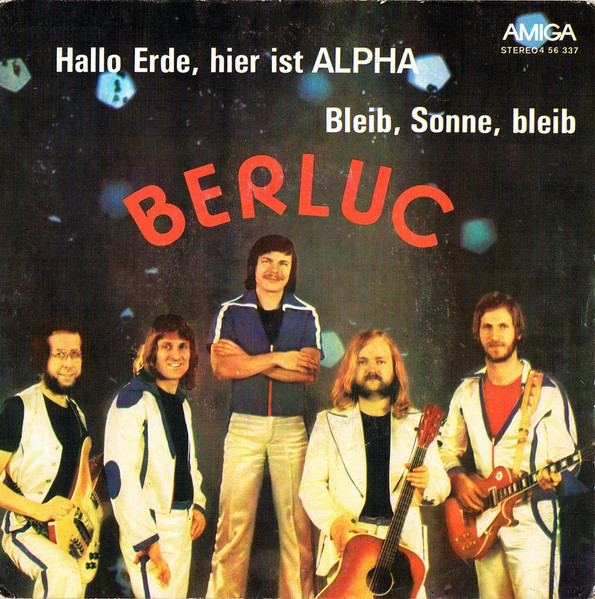
04. Berluc - Hallo Erde, Hier Ist Alpha (1978) 
                single (78) and album Reise Zu Den Sternen (79)
05. SOK - Sok-Oriental (1971)
                from retrospective SOK feat. Anders, Forsthoff, Gumpert, Sommer
06. Karussell - Ehrlich Will Ich Bleiben (1979)
                from album Entweder Oder
07. Stern-Combo Meißen - Hat Der Tag Sein Werk Vollbracht (1975)
                from collection Beatkiste Vol. 6
08. Puhdys - Ikarus (1974)
                from album Die Puhdys
09. Express - Leben, Um Ein Mensch Zu Sein (1973)
                from collection Hallo Nr. 8
10. Reform - Drachentoter (1979)
                from album Reform
11. Lift - Neuer Tag Bricht An (1976)
                from collection Beatkiste Vol. 3
12. Thomas Natschinski-Gruppe - Auf Dem Bau (1972)
                from album Wir Über Uns
13. Joco-Dev-Sextett - Stapellauf (1971)
                single
14. Peter Holten-Septett - Weiter Weiter (1975)
                from collection Beatkiste Vol. 2
15. Klosterbrüder - Lied Einer Alten Stadt (Weimar) (1975)
                single


"Wir Über Uns" LP
Thomas Natschinski-Gruppe - In Der Vierten Stunde (1972)
This is a stately piece of keys-lead prog that makes for a good opener before the heaviness begins, and the band make another appearance in this comp for track 12. Thomas Natschinski's group started out as successful beat band "Team 4", and made 3 LPs on the Amiga label. They morphed into a prog band that played a variety of pop to hard rock. Thomas Natschinski later become a music producer for soundtracks of many movies and TV shows, and has a website (link). More can also be read at deutsche-mugge (link) and ostmusik (link).

Electra - Bemuhe Dich single
Electra - Bemuhe Dich (1975)

Here's an excellent hard-rocker with great guitar. This was a single in 1975 and can be found on the 2004 retrospective "35 Jahre Electra", which has lots of heavy tracks of equal quality. They were also well know for making prog rock adaptations of Classical pieces. The last time the band appeared live was in 2015. One of the longest-running of East German prog bands, they changed completely throughout their history. Established in Dresden in 1969, and although quite popular, they were considered too radical to get an album released, instead they spent much of their time as backing band to various pop singers. 

Their 1974 debut album amounted to an early history of the band, followed by 3 other albums that are considered to be their definitive progressive rock era. In the 1980s they adopted a more mainstream pop rock style and became very popular in the DDR. There's an interview with Bernd Aust of Electra at ostmusik (link). Some more biography can be read at ostbeat (link), deutsche-mugge (link) and ostmusik (link).

Gisela Dreßler - 48 Crash
Gisela Dreßler - 48 Crash (1974)

Here's a fun Suzi Quatro cover. Gisela was a member of the Rainer Bloß Combo and jazz rock group SOK, which also appears in this comp. According to Discogs this single was made in conjunction with Electra, Karl-Heinz Ringel (of Electra and Sander-Formation) has arrangement credits.

Berluc-
Hallo Erde, Hier Ist Alpha
Berluc - Hallo Erde, Hier Ist Alpha (1978)
Here's a track with stomping riffs, from a good hard rock album by Berluc. They derived their name from Berlin and Luckenwalde, the region of East Berlin where they originated. They made three albums of hard rock into the 1980s, and some singles after, but they have continued to play live right up this year, 2022 (youtube). Berluc have a website (link) and some biography can be read at deutsche-mugge (link) and ostmusik (link).

SOK feat. Anders, Forsthoff,
Gumpert, Sommer
SOK - Sok-Oriental (1971)
This is a killer funky jam with the jazzy drumming just making it totally addictive, and the fuzz guitar isn't doing any harm either! The guarantors of the high musical level of the band, founded in 1971, were musicians such as Ulrich Gumpert (of Klaus Lenz Big Band, Synopsis - piano, organ, vocals, composition, arrangements, band leader), Günter Baby Sommer (of Modern Jazz Big Band 65 - drums), saxophonist Helmut Forsthoff (of Klaus Lenz Big Band) and Ernst-Ludwig Luten Petrowsky (of Klaus Lenz Big Band, Synopsis). These musicians had a solid, mostly classical, music education.

Gumpert and Sommer also had their first steps in previous acts, such as the Manfred Ludwig Sextett and the groups of Klaus Lenz and Friedhelm Schönfelddid. The founding members also included guitarist Günter Dobrowolski, Gerd Lübke (bass guitar), Robert Tornev (trumpet, violin), Rainer Paschy (saxophone) and Hermann Anders (tuba, composition, arrangements). Lübke and Dobrowolski came from the beat scene. For a time, Hans-Joachim Graswurm also played as a guest musician with SOK. The group presented at Jazz in der Kammer on June 7, 1971.  In 1972 the line-up of the band was supplemented by the singer Barbara "Bärbel" Folz. She was replaced in mid-1973 by Gisela Dreßler, who had a distinctive blues voice. (wikipedia). Some more biography can be read at wikipedia (link) and ostmusik (link).


Karussell – Entweder Oder
Karussell - Ehrlich Will Ich Bleiben (1979)

Here's another piece of stately prog. Karussell was founded in 1976, from members of the Leipzig amateur band "Fusion" and former members of the band Renft, who appeared in vol136 (link) and will appear again in part 2 of TDATS DDR Rock, who had recently been banned by the GDR authorities. Founding members of Karussell were Wolf-Rüdiger Raschke, "Cäsar" Peter Gläser, Jochen Hohl, Reinhard "Oschek" Huth, Lutz Kirsten, Claus Winter and Bernd Schumacher. In 1978, they became professional thanks to a sponsorship agreement with the central council of the FDJ (wiki), the concert and guest performance directorate (wiki) and the band. The first positive side effect of this change was participation in the "Rhythm 78" festival. For many fans of the banned group Renft, Karussel was the legitimate successor. Some more biography can be read at deutsche-mugge (link) and ostmusik (link).

Stern-Combo Meißen - Hat Der Tag Sein Werk Vollbracht (1975)
Stern-Combo Meißen was founded in 1964 by Martin Schreier, Norbert Jäger and Bernd Fiedler in Meißen, near Dresden. One of the longest-serving bands in Germany, they first performed in 1964 at a party for pensioners in the "Luftbad Meißen-Spaar". In the early years, the band played covers of their influences, including Blood Sweat & Tears and Chicago, which is why three horns played in the group until 1973. Around this time the group turned professional, the musical style changed and influences changed. They now played songs by Pink Floyd, Emerson Lake & Palmer or Genesis and began to write their own songs in this style. Still playing is 2022 as "Stern Meißen", a recent show was reviewed at ostmusik.de (link). Some more biography can be read at deutsche-mugge (link) and ostmusik (link).

Puhdys – Die Puhdys 1974
Puhdys - Ikarus (1974)
Puhdys emerged from the Udo Wendel combo founded in 1965. The band name consists of the initials of the original line-up, Peter Meyer, Udo Jacob, Harry Jeske and Dieter Hertrampf. The "ys" was added to the end and Puhdys were born. The group first played songs from their favorite bands Deep Purple, Led Zeppelin, Uriah Heep and others. Even though the original Puhdys had been active since 1965, the band's concert in Freiberg's "Tivoli" on November 19, 1969 is considered the official founding of Puhdys. This day was celebrated regularly as the band's 'birthday' until the band dissolved in 2016. Puhdys first appeared in vol48 (link) and are one of the most famous DDR rock bands and their earlier albums contain a lot of good hard rock. Some more biography can be read at ostbeat (link) and deutsche-mugge (link).

Gruppe ,Express' Berlin
Express - Leben, Um Ein Mensch Zu Sein (1973)
This Berlin band was active until 1990, but never released an album, and had only a few songs released on single, that were recorded for radio. The band was formed around 1971-2 as an amateur band . They first gained notoriety appearing at the 10th "World Festival of Youth and Students" (link) in 1973 in East Berlin. At the 1974 Workers' Festival in Erfurt, the band was awarded for successful original compositions. In the same year they received the title "Excellent Amateur Dance Orchestra". In 1974, along with Puhdys, they provided music for the film "…Verdammt, Ich Bin Erwachsen" (link). Some more biography can be read at deutsche-mugge (link), ostmusik (link) and wikipedia (link).

Reform - Drachentoter
Reform - Drachentoter LP
Reform - Drachentoter (1979)
When Klosterbrüder (from Magdeburg, appearing at the end of this comp) broke up, two new bands emerged: some of the members founded the group Magdeburg (appearing in the next DDR volume), and guitarist "Matze" Blankenburg founded Reform in 1975. In addition to Jörg Blankenburg, the first line-up included Mike Demnitz on bass, Peter Piele on drums, Werner Kunze as second guitarist/keyboardist, and Frank Schönfeld as singer. Frank was the leader and frontman of Reform until 1977. He was followed by Stephan Trepte (Electra, Lift), who was the band's singer from 1977 until the band broke up in 1986. Some more biography can be read at deutsche-mugge (link) and ostmusik (link).


Lift - band
Lift - Neuer Tag Bricht An (1976)
Lift emerged from the "Dresden-Septett" and gave their debut concert on January 28, 1973 in Dresden. In the early days, the personnel carousel turned very quickly. In 1973 after Wolfgang Scheffler's departure, Franz Bartzsch joined on keyboards, and Stephan Trepte as singer. Bartzsch's affiliation was short-lived and he left the group after only a year and a half to go to Veronika Fischer's Band. Wolfgang Scheffler then returned. Werther Lohse, who is still the only remaining member from the early days, joined Lift in 1974, while guitarist Jürgen Heinrich and singer Christiane Ufholz left. Trepte then left in '76 and formed Reform. Henry Pacholski replaced him. During Scheffler's time in the army from May '75 to 1976, Michael Hausdorf and Peter Sandkaulen (guitar) came in for him first and Michael Heubach for Hausdorf from October '75, during which time the guitarist left and Scheffler, together with Pacholski, rejoined the band from October '76. Lift played recently in 2022, you can read a review of that at ostmusik (link). Some more biography can be read at ostbeat (link), deutsche-mugge (link) and ostmusik (link).

Joco-Dev-Sextett
Joco-Dev-Sextett
Joco-Dev-Sextett - Stapellauf (1971)
In 1965 founding JDS members Jörg Schenkel and Detlef Lüpke were playing with Conny Hassbach and Dieter Szredzek as the "Joco-Dev-Quartett". Soon there were changes in personnel, partly because Conny Hassbach wanted to study. Jörg and Detlef joined forces with former musicians from the group The Brightles, who had just been banned, and founded Joco Dev.

At the end of the 60's the group got the chance to make songs for radio, and new TV show "Notenbank". This is how the song "Stapellauf" came into being. Lyrics and music were written by Reiner Schubert, and the group developed the arrangement together. The first version of the song did not pass the editor's office because the lyric "Black ships came over the sea" was apparently classified as "reactionary and decadent". The director of Notenbank, Bernd Maywald, contributed alternative lyrics. An interview with Bernd can read at deutsche-mugge (link). The Amiga label released "Stapellauf" as a single in 1971, however, the radio version was not pressed, it was re-recorded for the single. Many Joco Dev members were in the '80s heavy metal band "Formel 1" later. Some more biography can be read at deutsche-mugge (link) and ostmusik (link).

Peter Holten-Septett
Peter Holten-Septett - Weiter Weiter (1975)
Nearing the end now and here's an incendiary track from this group that was founded in 1970 by band leader, singer and keyboardist Peter Grasnick. The band name changed over time: Peter Holten-Sextett, Septett, also the Peter Holten Band. The name Peter Holten was invented, because at the time Peter Grasnick was not allowed to appear as an amateur or professional musician, since he was studying law, and working as a musician was not allowed for students of this discipline.

The first line-up included Grasnick's wife Brigitte (vocals), singer Bernd Bangel, bassist Dieter Wiesjahn, guitarist and singer Victor Heyse, keyboardist Michael Peglau and drummer Bernd Schwitzke. The group used sophisticated lyrics, and was only on the road as a live act for a small proportion of its existence. In 1972 the group made its first radio performances, that were recorded for inclusion in various Amiga period compilations, but unfortunately the band doesn't appear to have had any of its own singles or albums released.

In 1975 almost all the members left the Septett. While the former members founded Babylon in 1975 (appearing in the next DDR TDATS), Peter and Brigitte Grasnick re-formed with newcomers Thomas Friedrich (singer), Wolf-Dieter Bienge (bassist), Julius Krebs (keyboards) and Peter Lucht (drums). In addition, former Joco Dev guitarist Peter Nehls joined, but left in 1978 and was immediately replaced by two new guitarists: Roland Wolter and Michael Otter. The newly formed band could not build on the old successes. There were no more album releases with the band's titles, although the new line-up produced more of their own songs. In 1979 the Holten Band disbanded. Some more biography can be read at deutsche-mugge (link), ostmusik (link) and wikipedia (link).

Klosterbrüder
Klosterbrüder - Lied Einer Alten Stadt (Weimar) (1975)
This is a song that was released via the Amiga label on a split single with Lift, who appeared earlier in this volume. Klosterbrüder existed in various forms from the remnants of early '60s beat band The Big Town Boys. Their religious name (Friars or "monk brothers") and their tendency to draw big crowds seemed to attract unfavorable attention and even performance bans from the authorities and in 1975 they dissolved, with members immediately forming two new bands, Magdeburg (in next DDR volume) and Reform (in this volume). An interview with Klosterbrüder / Reform guitarist Jörg "Matze" Blankenburg is up at deutsche-mugge (link), where there is also an interview with Klosterbruder's Dietrick Kessler (link), and some more biography can be read at deutsche-mugge (link), ostmusik (link) and the band's website (link). 

Thanks for listening, part 2 of DDR rock is now published and available HERE

Happy Holidays! Rich

Related listening:
The Day After The Sabbath 149: HALLO Nr. 2 - DDR Rock part 2


TDATS social links


Share via: